How Often Should a Perth Garage Door Actually Be Serviced?
Most garage door companies answer this with 'annually', which is a defensible average and a fairly useless recommendation. Perth is over 120 kilometres end to end and spans a genuinely wide range of conditions, and a door two streets from the ocean in Trigg is not living the same life as an identical door in Forrestfield.
Here is how we actually set the interval, and how you can work out yours.
Start with cycles, not years
Garage door springs are rated in cycles — one open and one close is a cycle — rather than in years. A common domestic spring set is rated somewhere around ten thousand cycles. That number does not care about the calendar.
A retired couple who open the door twice a day will take well over a decade to reach it. A household in Willetton or Rossmoyne with four drivers, school runs, sport and a garage that is also where the bikes and the freezer live can easily be doing eight to twelve cycles a day — and will get there in around three years. Same door, same springs, same suburb. Completely different service interval.
So the first question is not how old the door is. It is roughly how many times a day it runs. If you have never counted, count for a week; most people are surprised.
Then adjust for where you are
The coastal belt: twice a year
Anywhere the sea breeze reaches with salt in it — Cottesloe, City Beach, Swanbourne, Trigg, Scarborough, Sorrento, North Beach, Mosman Park, North Fremantle, Coogee and the belt between them — a six-monthly interval is the honest recommendation rather than an upsell.
The reason is specific: salt does its work on the parts you cannot see. It attacks the spring ends, the fixings, the track fasteners and the inside face of a roller curtain long before the powder-coated front shows a mark. A coastal door can look perfectly sound from the driveway while its springs are failing. Inspection is the only way to know, and inspection on an annual cycle in that environment is a year of not knowing.
Under the trees: watch the debris, not the clock
In the leafy established suburbs and right through the Perth Hills, the dominant maintenance issue is organic debris. Jarrah and marri drop continuously up on the scarp; the mature street trees through Shenton Park, Floreat, Dalkeith, Carine and Alfred Cove do the same at a gentler rate. All of it ends up in the bottom channel of a roller door and along sectional door tracks, where it grinds on every cycle and eventually makes the motor read an obstruction that is genuinely there.
For these addresses the interval is annual, but the between-service action matters more than the service: keeping the bottom channel and tracks clear yourself costs nothing and prevents most of what would otherwise become a call-out.
High-cycle commercial and strata: schedule on cycles
A basement shutter in an East Perth or South Perth apartment building, or a unit shutter in Malaga or Kewdale, can do more cycles in a week than a house door does in a year. Putting those on an annual calendar interval is not a schedule, it is a formality. They should be scheduled against the cycle count, and for genuinely heavy-duty doors that can mean quarterly. See commercial roller shutters and doors for how we handle those.
Everywhere else: annually
A domestic door in an inland Perth suburb, normal household use, no unusual exposure: annual is genuinely the right answer, and we will say so rather than manufacturing a reason for more.
What a real service actually covers
This is worth stating plainly, because 'service' is used loosely in this trade and sometimes means little more than a spray of lubricant and an invoice.
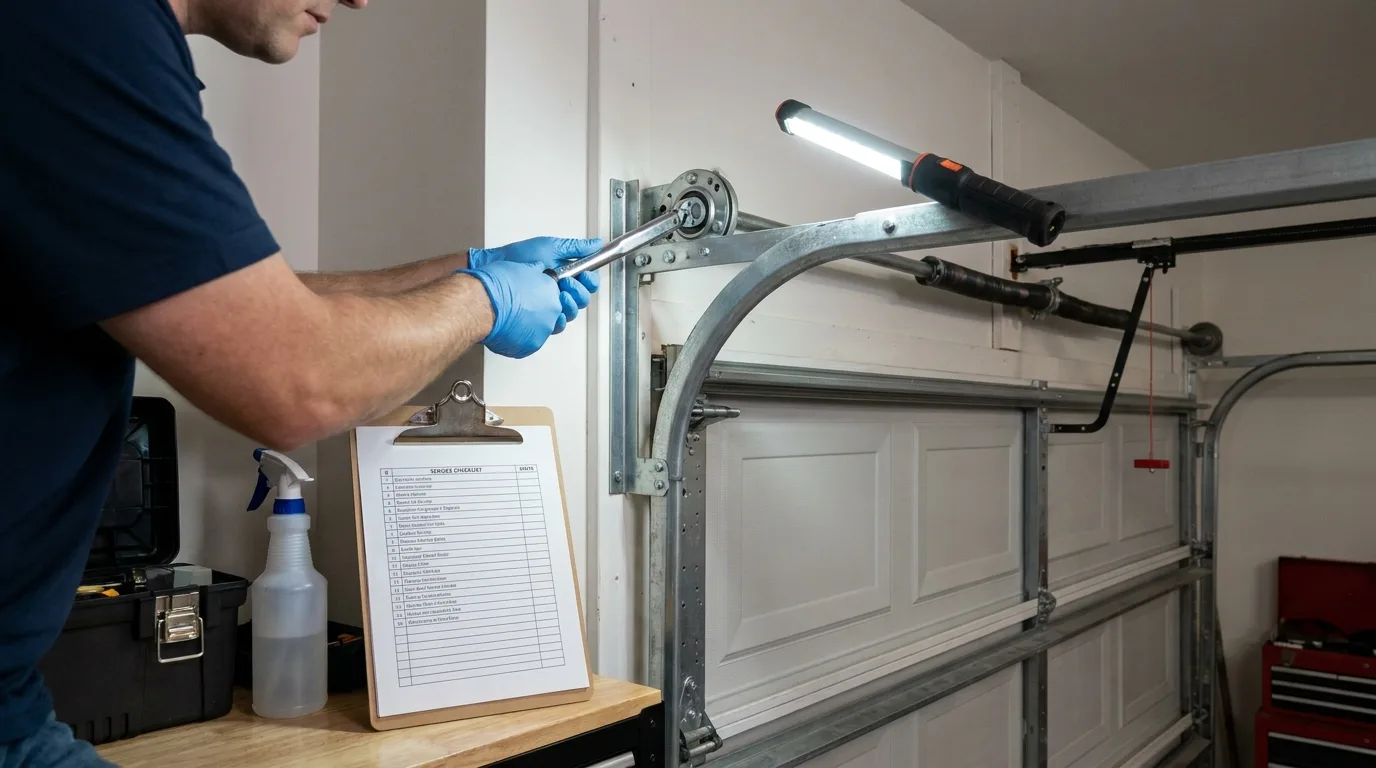
- A full balance test with the motor disconnected, through the door's complete travel — this is the part that finds a fatiguing spring while it is still a planned job.
- Spring condition and an assessment of remaining life against the cycle count.
- Cables, drums and shaft inspected for wear, fraying and correct seating.
- Rollers, bearings or the barrel checked for flat spots, play and seizure.
- Guides, tracks and the bottom channel cleared properly — not lubricated over the top of what has built up in them.
- Bottom rail and fixings checked for corrosion, which on a coastal address is the headline item.
- Motor travel limits and force settings verified against the actual door rather than left at whatever they were set to.
- Auto-reverse safety function tested, and the manual release checked and demonstrated.
- A plain report at the end: what is fine, what is approaching end of life and roughly when, what needs attention now.
The honest argument for doing it at all
Almost every emergency call-out we attend was preventable and was visible months earlier to anyone who knew what to look at. A spring past its cycle life. A door out of balance. A roller with a flat spot that is quietly loading the hinges. The expensive failures — a broken spring, a burnt-out motor, a cracked panel — are nearly all preceded by a cheap, findable condition.
The other argument is about timing rather than money. A service is the only visit where you choose when it happens. A failure chooses for you, and it tends to choose a Monday morning with the car behind the door. If you want to check your own door between services, the one-minute balance test is the single most informative thing you can do, and it needs no tools at all. Our garage door servicing page covers what we do and how we set intervals.