Replacing a Garage Door in a Perth Character Area
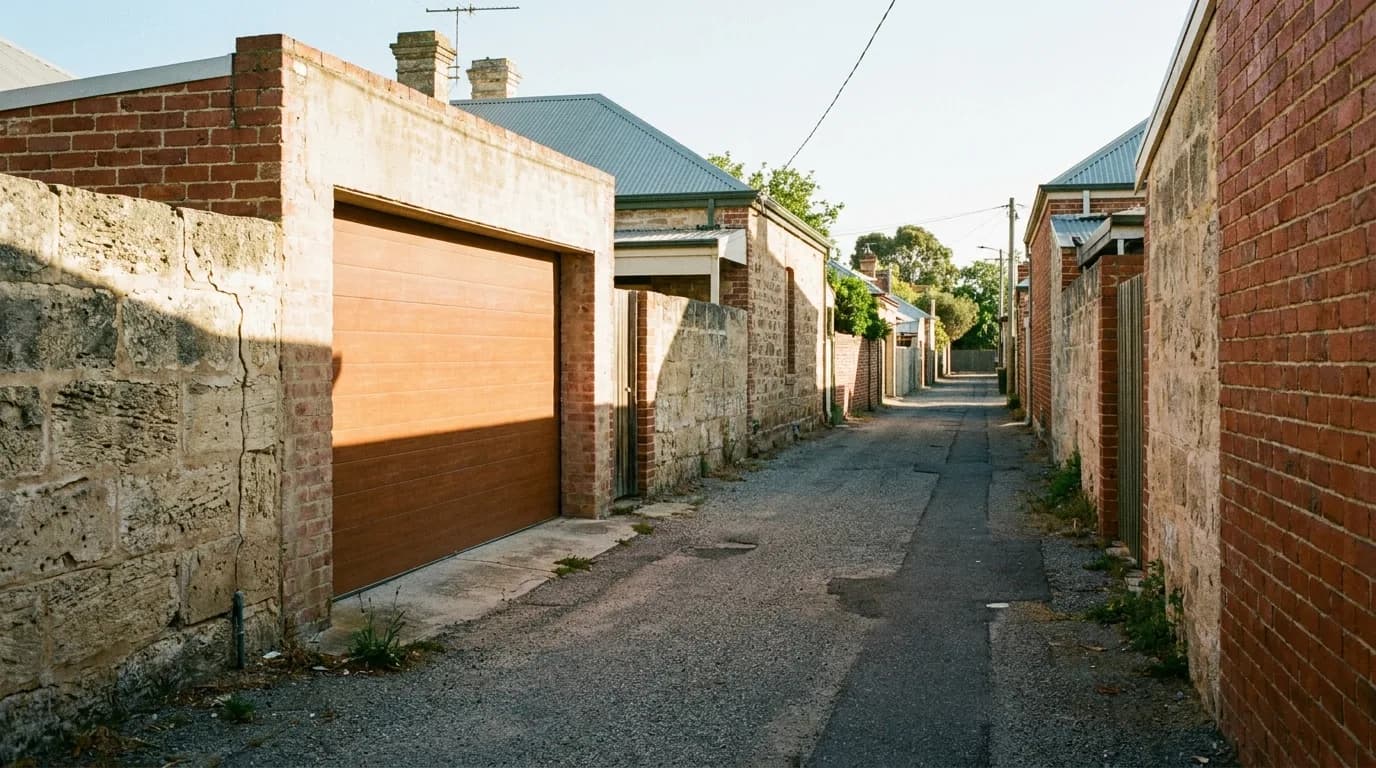
Perth's character housing was almost entirely built before the garage was a design assumption. Fremantle and East Fremantle limestone and timber cottages, Guildford's colonial and Federation stock, the Federation and inter-war homes through Mount Lawley, Inglewood, Highgate, North Perth, Subiaco and Claremont — in nearly all of it, the garage was added later. Cut into an existing wall, built at the rear, reached down a driveway barely wider than a car, or opening straight onto a laneway.
That produces a replacement job with a very different shape from a standard suburban one, and a specific way it goes wrong.
The order that saves money
Confirm what is permitted, then measure, then order. In that sequence.
Perth's character and heritage areas can carry local planning provisions governing what a street-facing replacement door is allowed to look like. Those provisions vary by council and by precinct, and they are not something a garage door company can rule on. What we can do is flag the question at the right moment — which is before manufacture, not after — and point you at your local council.
The failure mode is entirely avoidable and genuinely expensive: a made-to-measure door, manufactured to your specification, delivered, and then not permitted. One phone call at the right point in the process prevents it. If the door opens onto a rear laneway rather than the street, the question is often simpler, but it is still worth asking rather than assuming.
Headroom decides more than taste does
The most common constraint on character housing is headroom — the space between the top of the opening and the ceiling or roof structure. A sectional door needs somewhere for its tracks to curve back into the garage, and on a low-roofed garage built into a cottage that space simply does not exist.
This is why the roller door remains the correct answer on so many character properties rather than a compromise. It coils into a barrel above the opening and needs comparatively little room to do it. Where somebody has told you a sectional door is not possible on your garage, restricted headroom is almost certainly the reason, and it is a physical fact rather than a preference.
Side room matters too, and on a garage squeezed against a boundary — extremely common in Wembley, Doubleview, North Perth and the subdivided inner suburbs — there may be no clearance for vertical tracks on one side. All four measurements (headroom, side room, backroom, jamb condition) get taken before anything is discussed, which is the same discipline set out in what actually decides the outcome on a custom garage door.
Openings that are not a standard size
Character-era openings were cut to suit a vehicle, or a wall, or whatever the builder could make work — not to suit a door catalogue. Non-standard widths and heights are the norm rather than the exception.
There are two honest options and they should both be put to you. A made-to-measure door fits the opening you have, costs more than a stock size, and needs manufacturing lead time. Modifying the opening makes a stock door fit, and is real structural work on a wall that is part of a house you probably bought for its character. Neither is automatically right. What is wrong is being steered towards whichever is easier for the installer without the trade-off being explained.
The frame is as likely to be the fault as the door
On a retrofitted opening, the door is usually hanging off a timber frame that was fitted when the garage was added and has been carrying it ever since — in some cases for fifty or sixty years. When a character-area door starts binding, sticking or running out of square, the frame is at least as likely a cause as the door.
We check jamb condition at the estimate for exactly this reason. If the timber has gone soft it needs addressing before a new door goes on, and finding that out on installation day is how a half-day job becomes something else. It is also why the honest quote sometimes includes work you did not ask about.
Laneway access changes the job
A substantial share of garages in Mount Lawley, Inglewood, Highgate, Subiaco, South Fremantle and the older inner suburbs open onto a rear laneway with no apron. That has practical consequences worth raising when you book: there is often nowhere to stand a door while it is being fitted, no room to approach the opening square with a vehicle, and the door takes weather from a direction a street-facing door would be sheltered from.
It also explains a recurring fault in these suburbs. With no room to line up, vehicles clip the guides. A door running in a bent guide wears its curtain edge and its motor at several times the normal rate, so straightening a guide is a real repair rather than cosmetic — and it is far cheaper than what follows if it is left. That is routine roller door repair work.
What a good outcome looks like
- The planning question asked and answered before anything is manufactured.
- All four measurements taken, and the constraint that drives the door type named out loud.
- Jamb and frame condition assessed at quoting rather than discovered on the day.
- Made-to-measure and opening-modification both explained with their real trade-offs.
- A door that suits the period without pretending to be original.
- The old door removed and taken away, and the manual release demonstrated before we leave.
That is how we approach garage door installation and replacement on character housing, and it is why these jobs start with a conversation at the property rather than a price over the phone.