Garage Door Motors and Electrical Work: The WA Rules, Plainly
Search for a garage door company in Perth and you will find plenty describing themselves as licensed. It is worth knowing what that word can and cannot mean here, because Western Australia's rules are not the eastern states' rules and a couple of the claims in circulation locally do not correspond to anything real.
None of this is difficult. It is just rarely explained straight.
There is no garage door licence in WA
Building and construction in Western Australia is regulated by Building and Energy, part of DEMIRS, supported by the Building Services Board. There is no QBCC here — that is Queensland — and no NSW Fair Trading.
Among the licence and registration categories that exist in WA, there is no category for garage door installation or repair. It is not a licensed trade. So a Perth company describing itself as a 'licensed garage door installer' is not pointing at a credential you could look up, because that credential does not exist.
That is not an accusation of dishonesty — most of the time it is loose marketing language rather than a deliberate claim. But it does mean the word tells you nothing, and it is why this site does not use it. What can be verified is different: an ABN, a public liability insurance certificate, industry association membership, and a review history with enough volume behind it to be meaningful. Those are the things worth asking for.
One word that is simply wrong here
You will see 'licensed, bonded and insured' on Perth garage door websites. 'Bonded' is an American construct — a surety bond arrangement common in United States contracting — with no equivalent meaning in Western Australian trade licensing. When it appears on an Australian site it has been copied from overseas marketing copy. It is a small thing, and it is a reasonable signal about where the rest of the text came from.
Where registration genuinely bites: builder registration
Builder registration in WA is required for building work valued at $20,000 or more for which a building permit is required, and registrable work includes the renovation, alteration, extension, improvement or repair of a building.
Separately, since 1 July 2026, constructing a Class 10a building — which under the National Construction Code means a non-habitable building including a private garage, carport, shed or the like — valued under $50,000 does not require a registered building contractor. Building permit requirements still apply in their own right.
For ordinary garage door work, neither threshold is reached. Replacing or repairing a door on an existing garage is not constructing a Class 10a building, and it does not approach the registration threshold for building work. If you are building a new garage, that is a different conversation and a different trade.
Where licensing genuinely bites: electrical work
This is the distinction that actually matters, and it is the one nobody in this market draws clearly.
Electrical work in WA is regulated by EnergySafety, within Building and Energy, under the Electricity (Licensing) Regulations 1991. Electrical installation work requires a licensed electrical contractor employing licensed electrical workers, and most installation work requires a Certificate of Compliance for Electrical Installation.
Applied to a garage door motor, the line falls here:
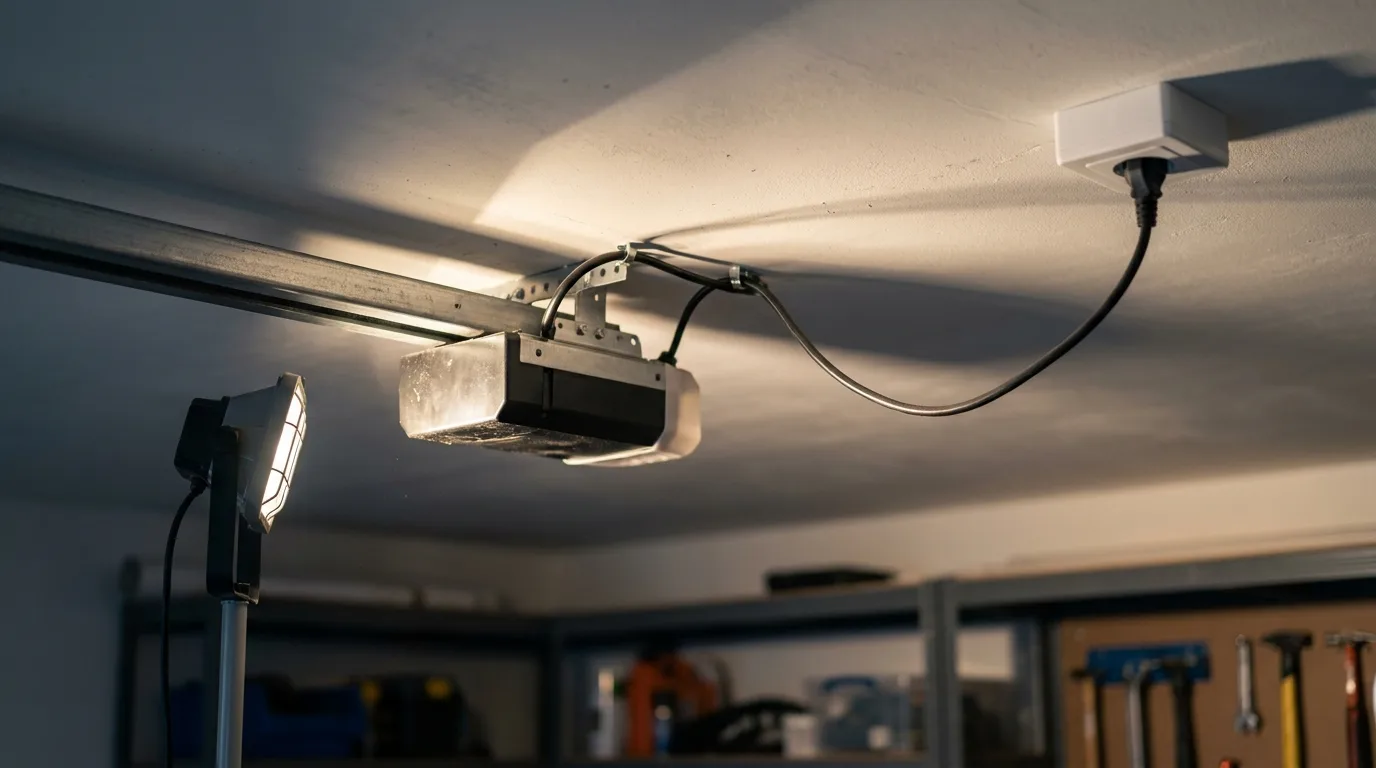
- Plugging a modern opener into an existing power point in the garage is not electrical installation work. Most Perth openers are plug-in units and most Perth garages already have an outlet. A garage door technician can do this.
- Adding a new power point, or hard-wiring a motor into the fixed wiring, is electrical installation work. That needs a licensed electrical contractor and, in most cases, a Certificate of Compliance for Electrical Installation. A garage door technician cannot do this, and should not.
That is the whole rule. It is not complicated, and it is genuinely useful to know, because it tells you which of two things is happening when someone quotes you: either your garage already has a power point and the job is straightforward, or it does not and a sparky is legitimately part of the work.
Our commitment on this is simple and it is written into how we quote motor and opener work: we will tell you when a job genuinely needs a licensed electrical contractor rather than quietly doing it ourselves, and we will tell you when it does not rather than adding a trade you do not need.
What to actually ask a Perth garage door company
- Do you have an ABN, and can I see it?
- Can you provide a current public liability insurance certificate?
- If my garage has no power point, who does that part of the work?
- What is the warranty on parts, and separately on workmanship?
- Will I get a written estimate before any work starts?
- Where can I read your reviews, and how many are there?
Notice what is not on that list: any request to see a garage door licence, because there is nothing to see. A company that produces one is producing something that does not exist.
Two more things WA-specific worth knowing
First, on wind ratings. You may see Perth garage doors marketed against a wind region or a wind rating. Wind classification under the relevant Australian Standards is a certified assessment, sources on Perth's classification are not consistent, and we will not publish a figure we cannot stand behind. Referring to the standard covering garage doors and other large access doors generically is fine; asserting a rating for your specific address is not.
Second, on cyclones. Cyclone-rated door marketing belongs to northern Western Australia — Port Hedland, Karratha, Broome. Perth is not in cyclone territory, and importing that language into a Perth quote is a sign the copy came from somewhere else.