Who Is Actually Responsible for the Strata Basement Door?
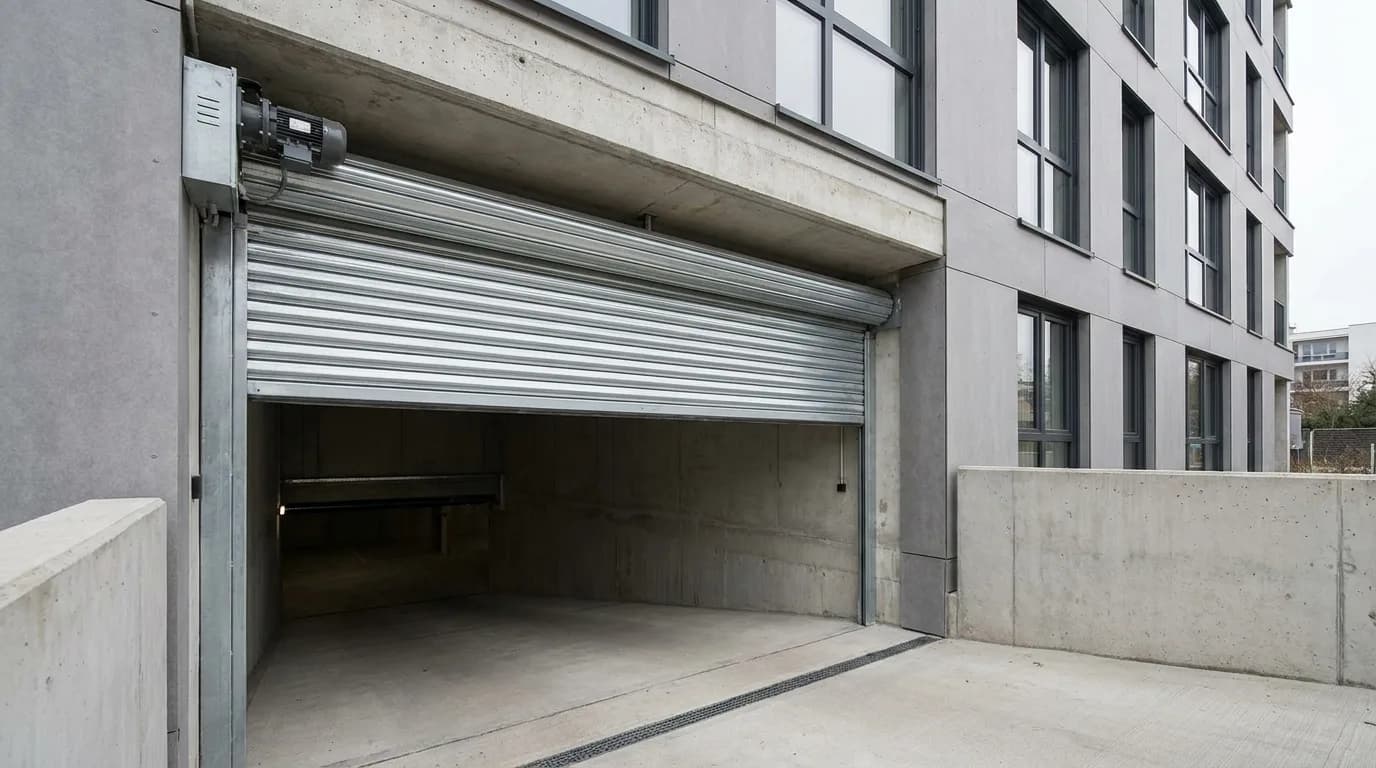
Perth's inner suburbs have changed shape fast. East Perth, South Perth, Rivervale, Innaloo, Stirling, Bayswater, Scarborough, Claremont, Subiaco — all of them now carry a substantial apartment population, and every one of those buildings has a door between the street and the cars.
Those doors are the hardest-worked and least-maintained garage doors in the metro, and the reason is not mechanical. It is that nobody is quite sure whose job it is.
A strata door is a different machine
A domestic garage door does perhaps four cycles a day. A basement shutter serving a forty-unit building can do fifty, eighty, a hundred — more in a building with visitor parking or a commercial tenancy on the ground floor. That is not a difference of degree, it is a different duty class.
Springs are rated in cycles. So are bearings, drive assemblies and control gear. A door doing twenty-five times the cycles of a house door reaches the same wear milestones in a twenty-fifth of the time, which means a schedule built on the calendar is not a schedule at all. The first question worth asking about any commercial or strata door is not how old it is but how many times a day it runs.
The consequences of failure are different too. A house door that fails inconveniences a household. A basement shutter that fails at seven in the morning strands every resident above it, and a shutter that fails stuck open leaves an entire building's cars accessible from the street overnight.
The reason it never gets serviced
In our experience it is almost always the same thing: the door is common property, the cost is shared, and no individual owner has it as their problem. It works, so nobody raises it. When it eventually fails, it fails as an emergency, and the emergency gets fixed — but the underlying schedule still does not get set, because the same ambiguity is still there.
There is often a second layer. Where a building has individual lock-up garages or bays as well as a shared entry shutter, the boundary between common property and individual lot property is genuinely unclear to the people making the decision. That ambiguity is enough to stall a quote indefinitely, and it usually does.
How to unstick it
The practical answer we have found is to quote in a form that separates the two: what is common property work on the shared entry door and its control gear, and what is bay-specific work on individual doors. Put in front of a strata council, that distinction is usually what allows a decision to be made, because it lets the council approve the part that is unambiguously theirs without waiting to resolve the part that is not.
It also lets individual owners deal with their own bay doors independently rather than waiting on a meeting. We quote commercial roller shutters and doors this way as standard for exactly that reason.
What a strata door schedule should cover
- Barrel or spring condition assessed against the cycle count rather than the calendar.
- Bearings and drive assembly — the components that go first on high-cycle doors.
- Control gear, boards, key switches and any access control integration.
- Safety edge and photocell function, tested and documented. On high-traffic doors these get bypassed after previous repairs more often than anyone would like, and a bypassed safety edge on a door this size is a serious matter.
- Guides, bottom rail and impact damage — basement ramps concentrate vehicle traffic through one opening.
- Manual operation in a power failure, and whether the people who would need to use it know how.
New buildings are not exempt
A common assumption is that a new development's door is fine for its first few years. It is running high cycles from its first month, and the maintenance ambiguity exists from day one — often more sharply, because a new strata council has not yet established who arranges what. We regularly attend basement doors on buildings under five years old that have never had a scheduled service in their lives.
Setting the schedule in the first year, while the building is new and nothing is wrong, is both the cheapest and the easiest moment to do it. It is also when the warranty position is clearest.
The coastal and CBD variations
Two Perth-specific notes. In coastal apartment buildings — Scarborough, Cottesloe, North Fremantle, Mosman Park — you have high cycles and salt exposure at the same time, which is the harshest duty combination a door can have in this city. Those buildings need shorter intervals than an inland equivalent, and coastal-grade hardware on any replacement component; the mechanism is set out in salt air and coastal garage doors.
And in the CBD and West Perth, where car-park doors serve offices and consulting suites rather than residents, the economics shift again: the cost of a failure is a morning's worth of people who cannot park, which makes out-of-hours planned work considerably cheaper in real terms than a business-hours repair. Where a site allows it, that is what we suggest.